
Grand reopening, now taking pre-orders: 20% off everything until Wednesday 4 November, 17:00
Order now and secure your cuts. The first orders ship on Wednesday 4 November with SEUR Frío (refrigerated courier) and arrive the next day (Balearic Islands: two days).
On orders from €129: free delivery to mainland Spain and a free tray of 4 criollo sausages.
Wagyu raised in Spain · Entrecot · Lomo bajo · Delivered chilled
Wagyu in Spain: Spanish-Raised Wagyu Entrecôte and Striploin, Delivered Chilled
If you have been looking for wagyu since you moved to Spain, we do have it, and we would rather tell you exactly what it is than dress it up: ours is wagyu raised in Spain, not imported from Japan. You can buy wagyu online in Spain from our butcher’s in Seville, in two boneless loin cuts: an entrecôte (entrecot de wagyu) and a striploin (lomo bajo, which is sirloin in Britain). Both are vacuum-packed and on pre-order, with the first refrigerated delivery on Thursday 5 November on the Spanish mainland. Both are sold by weight: the figures shown, €179.90 and €169.90, are prices per kilo.
See the two wagyu cuts Entrecot and ribeye explained
- Two cuts: entrecôte and boneless striploin
- Raised in Spain, not imported from Japan; no marbling grade is quoted
- Vacuum-packed, first chilled delivery on Thursday 5 November before 13:00 on the Spanish mainland

Wagyu raised in Spain, to order online
Both products are wagyu raised in Spain, sold by weight at a price per kilo. The listings do not state the weight of the piece you receive, so before you order, check the Spanish product page or tell us on WhatsApp how many people you are cooking for. Pre-orders placed by Wednesday 4 November 2026 at 17:00 get 20% off in the basket; the first parcels ship that day and arrive on Thursday 5 November.
Wagyu striploin, boneless, raised in Spain
Lomo bajo sin hueso de wagyu169,90€ VAT incl.Add to basket


The everyday versions of the same cuts
Wagyu is for the occasion. For the other Saturdays: two entrecôte steaks of retinto mature cow (650 g), two of Black Angus (675 g), and our best seller, the retinto cow chuletón of approx. 1 kg.
2 retinto cow entrecôte steaks, aged 30 to 45 days, 650 g
2 entrecots de vaca retinta madurados de 30 a 45 días, 650 g34,90€ VAT incl. (€53.69/kg)Add to basket2 Black Angus entrecôte steaks, aged 30 to 45 days, 675 g
2 entrecots de Angus madurados de 30 a 45 días, 675 g36,90€ VAT incl. (€54.67/kg)Add to basketChuletón (bone-in rib steak), retinto cow, aged 30 to 45 days, approx. 1 kg
Chuletón de vaca retinta madurado de 30 a 45 días, 1 kg aprox.63,90€ VAT incl. (€63.90/kg)Add to basket
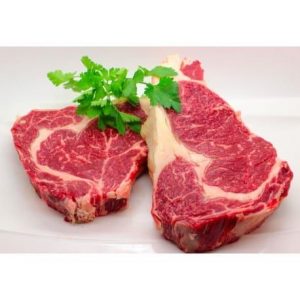
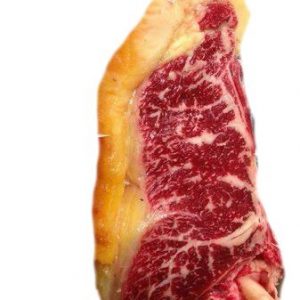

Entrecôte or striploin: the two cuts in Spanish terms
Both come from the loin, the long muscle on either side of the backbone. Spanish butchers divide it into lomo alto, the rib end (ribeye), and lomo bajo, the sirloin end (US: striploin, New York strip). The striploin is named after its place on the animal, so you know what you are getting. Entrecot is a looser word: a boneless steak from the loin, which can come from either end. If the difference matters, ask us which end the current entrecôte is cut from. The general rule is on our ribeye and sirloin pages.
| Our product | Spanish label | British (US) name | What the listing does not say |
|---|---|---|---|
| Wagyu entrecôte, raised in Spain | Entrecot de Wagyu | Boneless loin steak: ribeye or sirloin (US: striploin) | Which end of the loin; weight; grade |
| Wagyu striploin, boneless, raised in Spain | Lomo bajo s/hueso Wagyu | Sirloin (US: striploin, New York strip) | One piece or cut steaks; weight; grade |
About grades
Many people arrive here looking for a letter and a number. A5 is the highest mark in Japan’s own grading system, given to wagyu raised and graded in Japan, and Kobe is a regional Japanese name. Ours is wagyu raised in Spain, so it is neither A5 nor Kobe. No marbling score, percentage of wagyu blood, farm or province is stated for these two products, and we will not invent one.
How to cook very marbled beef
- Think in small portions. The shop rule for boneless meat is 200–250 g per person; with wagyu most people are happy with less, plus a second course.
- Use a heavy pan or a flat griddle, very hot and dry. The meat brings its own fat, and it begins to melt the moment it touches the metal.
- Keep the time short: a fierce sear on each face and off. Long cooking melts the marbling out into the pan.
- Rare, 50–52 °C (122–126 °F), or medium-rare, 54–57 °C (129–135 °F), is as far as it should go.
- Avoid an open-flame barbecue (US: grill): the dripping fat flares and leaves soot on the meat.
- Rest it two or three minutes, slice it thin, add flaky salt. Serve plain things with it: rice, a green salad, bread.
A special-occasion purchase
At these prices wagyu is a birthday or a big December dinner, not a weekly shop, and we would rather say so than sell you a disappointment. For a steak night that costs a fraction, Spain has its own answer: mature cow. Our chuletón page explains the thick shared rib steak, and Black Angus is there if you prefer a breed you know from home. Vacuum-packed meat keeps in the fridge until the use-by date on the label, or can be frozen on arrival.

Wagyu questions
Is it A5?
No. A5 is a Japanese grade, for wagyu raised and graded in Japan. Ours is wagyu raised in Spain, and no marbling grade is stated for it, so we quote none.
Is it Japanese wagyu or wagyu raised elsewhere?
It is wagyu raised in Spain, not imported from Japan. The web address of the Spanish product pages still contains wagyu-japones, and a product name there may still show the word japonés; the animals are raised in Spain. The farm and the province are not stated.
How much wagyu do I need per person?
Less than of any other steak. Tell us the number of guests on WhatsApp and we will tell you which pieces are available, since the listing is priced per kilo and gives no pack weight.
Does it arrive fresh or frozen?
It is not among the items marked frozen in our list. It travels vacuum-packed on the refrigerated dispatch, and you can freeze it on arrival.
Can I order wagyu for December?
Yes, gladly. The recommended dispatch is Wednesday 16 December for delivery on Thursday 17; the last one before 24 December is Wednesday 23 for Thursday 24 before 13:00, with no margin for a second attempt. Details on the December delivery page.