
Grand reopening, now taking pre-orders: 20% off everything until Wednesday 4 November, 17:00
Order now and secure your cuts. The first orders ship on Wednesday 4 November with SEUR Frío (refrigerated courier) and arrive the next day (Balearic Islands: two days).
On orders over €129: free delivery and a free tray of 4 criollo sausages.
Retinto · Native breed · Cádiz · Yearling, cow and ox
Retinto Beef: the Red Cattle of South-West Spain, and Which Cut to Try First
If you keep seeing the word retinto on menus and labels and nobody has explained it, here is the explanation. Retinto is a native cattle breed of south-west Spain (Andalusia and Extremadura), named after its deep red coat and raised outdoors on the dehesa, the open oak pastureland. Carne de retinto on a menu simply means beef from that breed. Ours comes from the province of Cádiz and is sold at three ages: yearling, mature cow and ox.
See the retinto cuts What is a chuletón?
- Retinto cattle from the province of Cádiz, raised outdoors
- Three ages to choose from: añojo, vaca and buey
- Vacuum-packed, delivered chilled on Thursday before 13:00 on the Spanish mainland
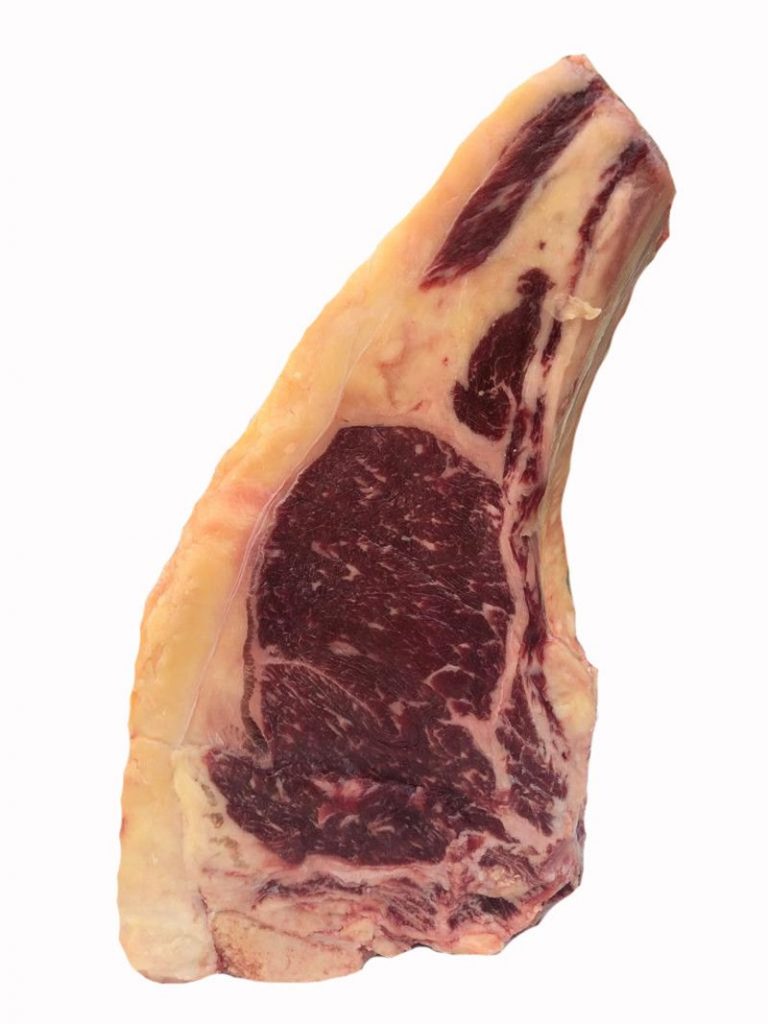
Retinto steaks, from the mildest to the rarest
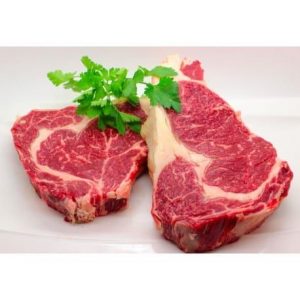
Three of these cards are the same steak, the chuletón (a thick bone-in rib steak for sharing), at the three ages retinto is sold at. The age shows in the price: the yearling chuletón is listed at €36.90 and the ox at €99.90. The fourth card is two boneless entrecôte steaks from mature cow, 650 g. The shop reopens on Thursday 5 November 2026; pre-orders until 4 November carry 20% off in the basket.
Chuletón (bone-in rib steak), retinto cow, approx. 1 kg
Chuletón de vaca retinta, 1 kg aprox.63,90€ VAT incl.Add to basketChuletón (bone-in rib steak), retinto yearling beef, approx. 1 kg
Chuletón Añojo Retinto36,90€ VAT incl.Add to basket2 retinto cow entrecôte steaks, 650 g
2 entrecots de vaca retinta, 650 g34,90€ VAT incl.Add to basketOx chuletón (buey), native retinto breed, 1 kg
Chuletón de Buey Retinto – Raza Autóctona 1 kg99,90€ VAT incl.Add to basket



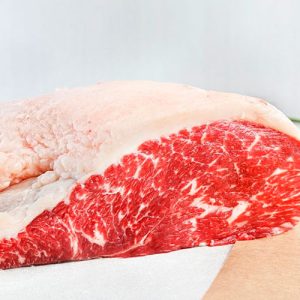
Retinto for the barbecue and the pot
A 1.5 kg piece of yearling skirt steak, a flank steak of approx. 1.2 kg, a whole picanha of 1.5–2 kg that is 100% retinto, and 1 kg of yearling ox cheek (US: beef cheek) for a slow braise.
Skirt steak (entraña), retinto yearling beef, 1.5 kg
Entraña Añojo Retinto 1,5 KG44,90€ VAT incl.Add to basketWhole picanha (rump cap), 100% retinto, 1.5–2 kg
Picanha 100% Retinto, pieza completa 1,5 a 2 kg59,90€ VAT incl.Add to basketOx cheek (carrillada), retinto yearling beef, frozen
Carrillada de añojo31,90€ VAT incl.Add to basket



Why the word keeps turning up on Andalusian menus
Spanish menus often name the breed as well as the cut, and in the south-west the local breed is retinto. Eat out along the Cádiz coast and you will meet it on menu after menu. The name comes from the coat: a dark red somewhere between mahogany and chestnut. It is a hardy animal, made for long hot summers and traditionally raised extensively on the dehesa.
On the plate that means deep red meat, fat that is well spread through the muscle and a more pronounced flavour than everyday Spanish beef. It suits a hot grill and a slow braise alike. Ternera retinta, vaca retinta and carne de retinto de Cádiz are all the same breed. Only the age of the animal changes.
Three ages, three different meats
| Age | What it tastes like | The cut to start with | Our product |
|---|---|---|---|
| Añojo, yearling beef (12–24 months) | Mild and tender, pale red, with white fat. The gentle one. | Skirt steak on the barbecue | Skirt steak (entraña), 1.5 kg piece; yearling chuletón, approx. 1 kg |
| Vaca, mature cow (female over 48 months) | Darker meat, yellow fat, more marbling and a deep flavour. The meat behind the famous Spanish chuletón. | The chuletón, shared | Mature cow chuletón, approx. 1 kg (our best seller); 2 entrecôte steaks, 650 g |
| Buey, ox (castrated male over 48 months) | The deepest flavour and the most generous fat of the three. Rare and expensive. | The ox chuletón, for an occasion | Ox chuletón, 1 kg |
Which one to try first
If you have never eaten old cow beef, start with the mature cow chuletón. It is the steak people mean when they talk about retinto. If a kilo on the bone is more than you need, the two entrecôte steaks are the same meat without the bone; our ribeye page explains what entrecot covers in Spain. If you prefer milder beef, take the yearling. Leave the ox until you know you like cow.
The criollo side: retinto cut for the barbecue
Retinto is cut here the criollo way as well as the Spanish way: skirt (entraña), flank (vacío) and picanha with its fat cap left on.
Cooking retinto
- The butcher’s rule for the barbecue (US: grill): embers, never flames, and coarse salt at the end.
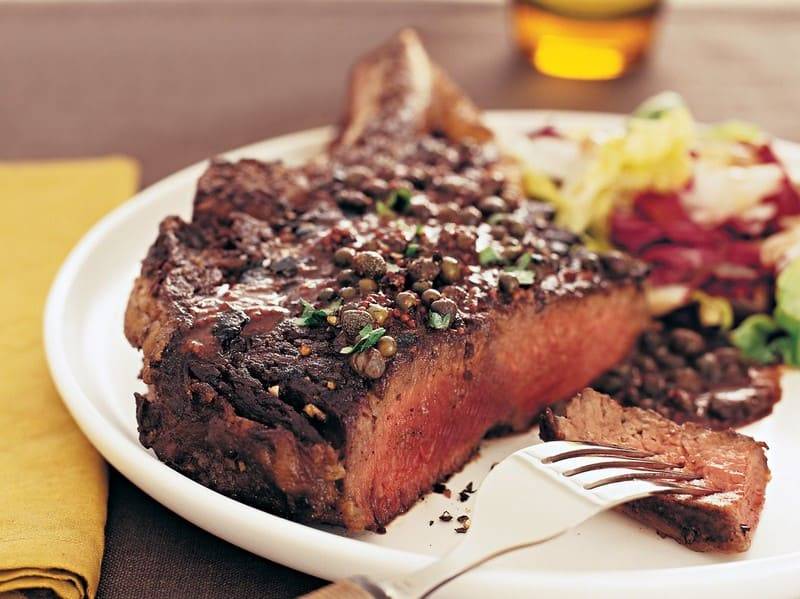
- Chuletón: out of the fridge well ahead, a hard sear, then rare at 50–52 °C (122–126 °F) or medium-rare at 54–57 °C (129–135 °F) in the centre.
- Skirt: strong heat and a short time. Slice it across the grain.
- Picanha: whole or in thick steaks, and do not trim the fat cap.
- Ox cheek: brown it, then braise it for 3–4 hours in a low oven, 140–160 °C (285–320 °F).
Retinto questions
What does “carne de retinto” mean in English?
Retinto beef. Retinto is the name of a breed, so it is not translated.
Is retinto beef from Cádiz?
The home of the breed is western Andalusia and Extremadura, which is dehesa country. Our retinto comes from the province of Cádiz.
Is ternera retinta veal?
Usually not, no. Most Spanish shops use “ternera” loosely for añojo, yearling beef of 12–24 months. It is mild, tender and pale red, but it is beef.
Are there other native Spanish beef breeds?
Yes, and Spanish menus often name them. Retinto is the native breed of the south-west and the one we sell; we also stock Black Angus. The age names that go with any breed, from ternera to buey, are in our guide to beef cuts in Spanish.
Does it arrive fresh or frozen?
The retinto cuts on this page arrive chilled and vacuum-packed. They keep in the fridge until the use-by date on the label, or you can freeze them on arrival.