
Grand reopening, now taking pre-orders: 20% off everything until Wednesday 4 November, 17:00
Order now and secure your cuts. The first orders ship on Wednesday 4 November with SEUR Frío (refrigerated courier) and arrive the next day (Balearic Islands: two days).
On orders over €129: free delivery and a free tray of 4 criollo sausages.
Slow cooking · carrillada · rabo de toro · jarrete
Stewing beef in Spain: ox cheek, oxtail and shin, and what to call them
If you have just arrived and are looking for something to put in the slow cooker on a cold evening, Spanish butchers have you well covered. Ox cheek (US: beef cheek) is carrillada, oxtail is rabo de toro, shin of beef (US: shank) is morcillo or jarrete, and diced stewing beef is carne para guisar, asked for “en tacos“. Chuck is aguja. We sell ox cheek, oxtail, a whole shin and ready-diced stewing beef, vacuum-packed and delivered chilled.
See the slow-cooking cuts Roasting joints instead
- Ox cheek and diced beef from retinto yearling, in 1 kg packs
- One chilled dispatch a week: order by Wednesday 17:00, delivered Thursday before 13:00 on the mainland
- Vacuum-packed: cook it this week or freeze it on arrival

Cuts for the pot
Ox cheek comes in 1 kg packs (€31.90) and so does the diced stewing beef (€24.90); both are retinto yearling beef, the native breed of south-west Spain at 12–24 months. Oxtail is sold in 1.5 kg options. The shin is one whole joint of approx. 2.5 kg, not diced. The whole brisket (pecho) is one piece of approx. 4 kg, for pot roast, salt beef or the smoker. The last card is ibérico pork cheeks, 1 kg, which give a similar texture in less time.
Ox cheek (carrillada), retinto yearling beef, frozen
Carrillada de añojo31,90€ VAT incl.Add to basketOxtail (rabo de toro)
Rabo de Toro o Añojo 1,5 kg Price range: 35,90€ through 349,90€ VAT incl.Choose weightShin of beef (jarrete / morcillo), whole retinto joint, approx. 2.5 kg
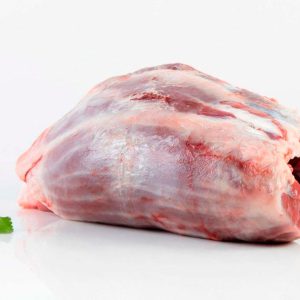
Jarrete de Vacuno Retinto — Morcillo, Garrón o Brazuelo Premium. Pieza completa de 2,5 kg aprox.57,90€ VAT incl.Add to basketDiced stewing beef, retinto yearling, 1 kg
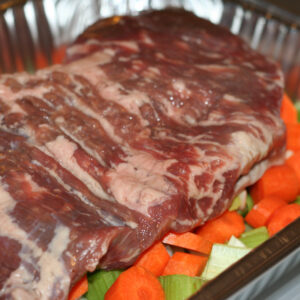
Carne Tacos Añojo Retinto, 1 Kg24,90€ VAT incl.Add to basketWhole beef brisket (pecho), retinto, approx. 4 kg
Pecho de retinto entero (brisket), 4 kg aprox.84,90€ VAT incl.Add to basketIbérico pork cheeks (carrilladas), 1 kg
Carrilladas de cerdo ibérico -1KG30,36€ VAT incl.Add to basket




Start from the dish, then pick the cut
British recipes say “braising steak” or “stewing beef” and leave the rest to the butcher. A Spanish counter works the other way round: you name the muscle. Times are for a low oven or a bare simmer.
| Cut | Spanish name | Texture after cooking | Typical time |
|---|---|---|---|
| Ox cheek | carrillada, carrillera | Very soft and sticky; holds its shape until you press it | 3–4 hours |
| Oxtail | rabo de toro, rabo de vacuno | Falls from the bone; the richest sauce of the lot | 3½–4½ hours |
| Shin | morcillo, jarrete | Long, firm shreds bound with gelatin | 2½–3½ hours |
| Diced stewing beef | carne para guisar, en tacos | Tender cubes, a lighter sauce | 1½–2½ hours |
| Brisket | pecho, aleta | Slices that hold together, with a fat cap that bastes them | 5–6 hours, covered |
| Chuck, braising steak | aguja | Soft, breaks into flakes | 2–3 hours |
| Ibérico pork cheeks | carrilladas ibéricas | Small, spoon-soft pieces | 1½–2 hours |
Beef and ale style stew, cottage pie filling, casseroles
Use the diced stewing beef if you want to get going straight away, or the shin if you want more body. Shin carries more connective tissue, so the gravy thickens on its own and needs less flour. Our shin is a whole 2.5 kg piece: portion it, cook half and freeze half. There is no card for aguja on this page; the diced beef does the same job. Short ribs braise well too.
Ragù
Shin or ox cheek, cooked in large pieces and shredded with two forks at the end. Cheek gives the silkier sauce. Both forgive an extra half hour, which mince (US: ground beef) does not.
Oxtail soup and Spanish rabo de toro
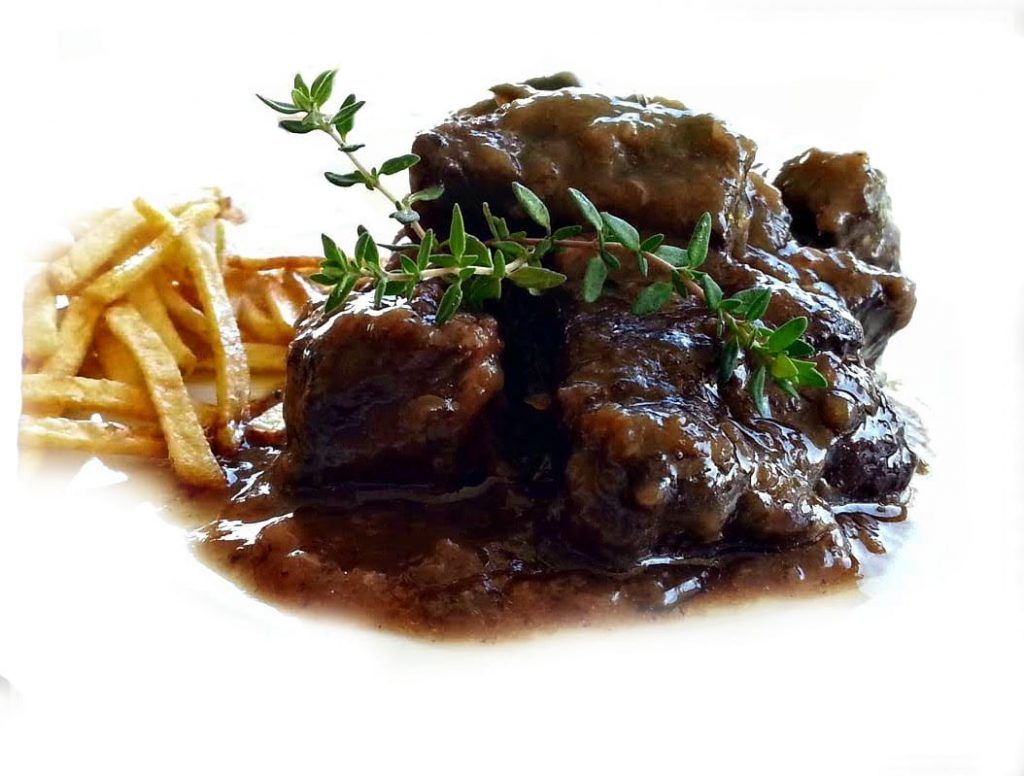
One cut, two directions. For a British oxtail soup, simmer the tail until the meat slips off, strain the stock, pick the meat and return it. For the Andalusian dish, the pieces are browned and braised in red wine with onion, carrot and garlic until the sauce turns glossy, and served on the bone.
Why the sauce sets to jelly
Cheek, tail and shin are working muscles, full of collagen. Long, moist heat turns it into gelatin, which gives the sticky texture. A stew made with them sets solid in the fridge overnight. That is a good sign, not a fault, and it melts again on reheating.
Method in six lines
- Pat the meat dry, season it and brown it in batches.
- Soften onion, carrot and celery or leek in the same fat; stir in a spoonful of flour or tomato purée.
- Add beer, red wine or stock to come two thirds of the way up the meat, not over it.
- Lid on, then into the oven at 140–160 °C (285–320 °F), or onto the lowest flame at a bare simmer.
- It is done when a spoon goes through the meat without resistance.
- Chill it overnight, lift off the fat and reheat gently. It is better the next day.
Slow-cooking cuts: short answers
What are beef cheeks called in Spanish?
Carrillada or carrillera; both words are in use. Pork cheeks use the same word, so add “de ternera” or “de vacuno” if you want beef. Ours are retinto yearling beef in 1 kg packs.
What is shin of beef in Spanish?
Morcillo or jarrete. The front leg is sometimes called brazuelo, and shin sliced across the bone is sold under the Italian name ossobuco.
Spanish recipes say “ternera”. Is that veal?
Usually not. By law ternera is an animal of 8–12 months, but most Spanish shops use the word loosely for añojo, yearling beef of 12–24 months. It is mild, tender and pale red, and it is what our ox cheek and diced beef come from.
Do you sell brisket?
Yes, we do: a whole retinto brisket of approx. 4 kg, uncut and with its fat cap. In Spain brisket is pecho, and some shops label it aleta, so ask for both names locally. It is a large piece: cook half and freeze half.
Can I use a pressure cooker?
Yes, and many Spanish kitchens do. In Spain it is sold as olla rápida or olla exprés. As a rough guide, allow about a third of the oven time, then reduce the sauce with the lid off.