
Grand reopening, now taking pre-orders: 20% off everything until Wednesday 4 November, 17:00
Order now and secure your cuts. The first orders ship on Wednesday 4 November with SEUR Frío (refrigerated courier) and arrive the next day (Balearic Islands: two days).
On orders over €129: free delivery and a free tray of 4 criollo sausages.
Lomo alto · Lomo bajo · Entrecot · Ribeye or sirloin
Lomo Alto vs Lomo Bajo: Which One Is Ribeye and Which Is Sirloin
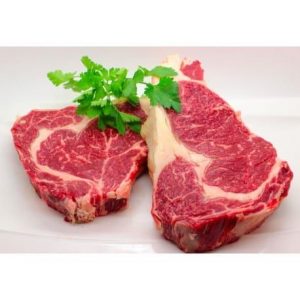
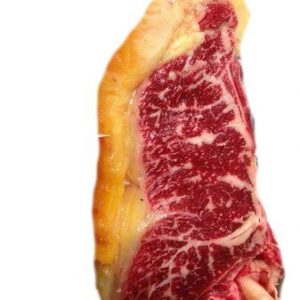
Lomo alto is ribeye: the front, rib end of the loin, with more marbling and a cap of fat, sold on the bone as chuletón. Lomo bajo is British sirloin (US: striploin, New York strip): the rear end, leaner and more even. They are one muscle cut in two places, and a boneless steak from either end can be labelled entrecot.
- Lomo alto is ribeye; lomo bajo is UK sirloin, US striploin
- Entrecot only means a boneless loin steak, so ask which end it came from
- American “sirloin” is neither of them: it is cadera, British rump
Side by side
| Lomo alto | Lomo bajo | |
|---|---|---|
| In Britain | Ribeye; rib of beef or fore rib on the bone | Sirloin |
| In America | Ribeye; prime rib on the bone | Striploin, New York strip |
| Where it sits | Front of the loin, next to the chuck (aguja) | Rear of the loin, alongside the fillet (solomillo) |
| Fat | More marbling, plus the cap | Leaner and more uniform, no cap |
| Shape of the steak | A round central eye with the cap wrapped around it | A regular steak, the same size from one end to the other |
| On the bone | Chuletón | Chuletón de lomo bajo; with the fillet attached, a T-bone |
| Boneless | Entrecot de lomo alto; also labelled ojo de bife or cube roll | Entrecot, the everyday one |
| Flavour | Fuller, because of the fat | Cleaner, plainly beefy |
| Doneness that suits it | Takes rare well: the fat melts and keeps it moist | Better not overcooked: there is less fat to protect it |
One long muscle, which is why there are two loins
The loin is the longissimus dorsi, a muscle that runs along the backbone above the ribs. It carries no weight and does no pushing, so it is tender from end to end. It is not the same all the way along, though, and that is where the confusion starts. Spanish butchers split it in two. The lomo alto is the front part, eight ribs long in the Spanish breakdown. The lomo bajo is the rear part, the one that lies against the fillet (US: tenderloin). When you see a whole loin on a Spanish counter you are looking at both, one after the other.
So which end is an entrecot?
The word is French, entre côtes, between the ribs, and in Spain it means a boneless slice of the loin. In everyday Spanish practice it tends to be cut from the lomo bajo, because that end gives regular steaks with no cap. A boned steak from the lomo alto is an entrecot too, and some people prefer it for the fat. What separates an entrecot from a chuletón is the bone, not the area. The chuletón vs entrecot guide goes through that choice.
At the counter, name the end and say how you want the bone:
- “Un entrecot de lomo alto, de tres centímetros”: a ribeye steak, 3 cm thick.
- “Dos entrecots de lomo bajo”: two sirloin steaks.
- “Un chuletón de lomo alto, con hueso”: a rib steak on the bone.
- “Sin hueso” is boneless; “con su grasa” keeps the fat on.
Which end for which job
A frying pan or griddle at home
Lomo bajo. The steaks are even, they cook the same on both sides, and cut at 3 cm or more they are easy to control. Under 3 cm the centre overcooks before a crust has formed.
The barbecue
Lomo alto. The cap and the marbling stand up to a fierce fire on the barbecue (US: grill), and the fat that drips is the flavour people want from charcoal. This is where a chuletón and a thick ribeye earn their place.
If you like it rare
Lomo alto. The marbling melts and keeps the meat moist even when the centre is red, at 50–52 °C (122–126 °F). The leaner lomo bajo is happier medium-rare, 54–57 °C (129–135 °F), or medium, 60–63 °C (140–145 °F).
If every plate has to match
Lomo bajo. It is the most regular piece on the animal, which makes it the one for a dinner where everyone gets the same portion of 200–300 g.
If flavour comes first
Lomo alto from a mature animal. A retinto cow over 48 months has a depth that a yearling does not reach. Strictly that is the difference between old cow and yearling, not between the two ends of the loin, but it shows most in the lomo alto because there is more fat to carry it.
The cut tells you the shape and the amount of fat; the breed and the age tell you the flavour. A yearling (añojo) has little marbling at either end.
Both ends of the loin, ready cut
Entrecôte steaks from retinto mature cow and from Black Angus, the retinto cow chuletón, and the T-bone, which is lomo bajo on the bone with the fillet on the other side. If you would rather have the whole piece and choose your own thickness, read how to cut a whole loin into steaks.
2 retinto cow entrecôte steaks, 650 g
2 Entrecot Vaca Retinta 650 gr (Más vendido)30,90€ VAT incl.Add to basketChuletón (bone-in rib steak), retinto cow, approx. 1 kg
Chuletón Vaca Retinta - MAS VENDIDO57,90€ VAT incl.Add to basketT-bone steak, retinto cow
T-Bone Vaca Retinta Price range: 48,40€ through 50,60€ VAT incl.Choose weight


Lomo alto and lomo bajo: short answers
What is lomo alto in English?
Ribeye. On the bone it is rib of beef or fore rib in Britain and prime rib in America; in Spain the bone-in steak is a chuletón and the boneless one an entrecot de lomo alto.
What is lomo bajo in English?
Sirloin in Britain, striploin or New York strip in America. American “sirloin” is a different cut, British rump, and in Spain that is cadera.
Is an entrecot lomo alto or lomo bajo?
It can be either. Entrecot means a boneless steak from the loin; in everyday Spanish practice it is more often cut from the lomo bajo, so ask for “entrecot de lomo alto” if you want ribeye.
Which is better, lomo alto or lomo bajo?
Neither; they are different. Lomo alto has more marbling and the cap of fat and gives more flavour over charcoal. Lomo bajo is leaner and more even, easier in a pan and better for equal portions.