
Grand reopening, now taking pre-orders: 20% off everything until Wednesday 4 November, 17:00
Order now and secure your cuts. The first orders ship on Wednesday 4 November with SEUR Frío (refrigerated courier) and arrive the next day (Balearic Islands: two days).
On orders over €129: free delivery and a free tray of 4 criollo sausages.
Chuletón · Entrecot · Bone in or bone out
Chuletón vs Entrecot: The Same Beef, With and Without the Bone
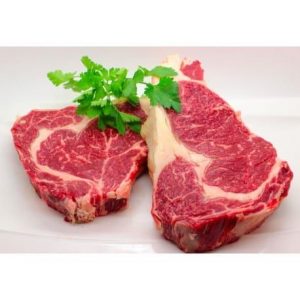
A chuletón is beef loin cut with the rib bone left on; an entrecot is the same muscle with the bone taken off. The chuletón is cut 4–5 cm thick, wants a barbecue (US: grill) and is shared. The entrecot is 2–3 cm, cooks in minutes and suits a pan at home. In British terms: rib of beef on the bone against a boneless ribeye or sirloin steak.
- Same muscle: the difference is the bone, the thickness and the fire
- Chuletón: 400–500 g per person. Entrecot: 250–350 g
- The bone does not flavour the meat; the animal’s age and fat do
Choose in thirty seconds
Buy a chuletón if:
- You have charcoal or a barbecue with a real fire.
- There are two or more of you and you want one piece to share in the middle of the table.
- You like the meat next to the bone, which stays juicier.
- It is a celebration and you want it to look like one.
Buy entrecot if:
- You are cooking in a frying pan (US: skillet) or on a griddle.
- You want one steak per person, with no carving and no sharing.
- You are short of time: it is done in a few minutes.
- You want the same beef on a tighter budget.
One muscle, two names
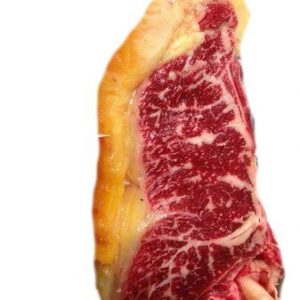
Both cuts come from the loin, the long muscle that runs along the animal’s backbone (the longissimus dorsi). Cut it with the rib attached and you have a chuletón. Bone it and slice it and you have entrecots. It is one muscle; what changes is the part of the loin. The lomo alto, the rib end, is the more marbled part and gives the classic chuletón and the ribeye. The lomo bajo, the sirloin end (US: striploin), is leaner and gives the everyday boneless entrecot. See lomo alto vs lomo bajo.
Does the bone add flavour?
The honest answer is no: the bone does not flavour the inside of the meat. What it does is different. The meat against the bone cooks more slowly, so it stays juicier, and the bone gives the steak presence on the table. The flavour itself comes from the breed, the age of the animal, the marbling and the ageing.
Thickness decides the fire
A chuletón demands thickness, 4–5 cm, and live fire. Any thinner and it overcooks before it browns. At that thickness a domestic hob struggles: you need strong heat, time and a proper rest. The method is in how to grill a chuletón.
An entrecot is 2–3 cm. It cooks fast, and that is why it works in a pan: a very hot pan or griddle, a couple of minutes a side, a rest and on to the table. It is the midweek steak. If you have no barbecue, do not force it: an entrecot cooked well in a pan beats a chuletón cooked badly.
Doneness
Both are at their best rare, 50–52 °C (122–126 °F) at the core, or medium-rare, 54–57 °C (129–135 °F). A chuletón’s thickness gives you room: sear hard and let the inside climb slowly. With an entrecot a minute’s distraction takes it from medium to well done. The full scale is in the steak doneness temperatures guide. In a Spanish restaurant rare is poco hecho, medium is al punto and well done is hecho.
What each one costs
A chuletón is bought with its bone, and bone weighs. Allow 400–500 g per person: a 1 kg chuletón feeds two good appetites, or three if there are starters. Boneless entrecot goes further, at 250–350 g per person; the sums are in how much steak per person. Side by side, in retinto mature cow:
| Chuletón, retinto mature cow | Entrecôte steaks, retinto mature cow | |
|---|---|---|
| Pack | One steak on the bone, approx. 1 kg | Two boneless steaks, 650 g in all |
| Listed price (September 2026) | €57.90 | €30.90 |
| Portion guide | 400–500 g per person, bone included | 250–350 g per person |
| Feeds | Two, sharing | Two, one steak each |
For two people the entrecôte pack comes to roughly half the money. With the chuletón you pay for the bone and the whole piece; with the entrecot you pay for meat only.
A third way: the T-bone
If you want the big piece on the bone and fillet (US: tenderloin) as well, the T-bone is lomo bajo on the bone with the fillet on the other side.
The animal matters more than the bone
Either cut can come from any beef animal, and a chuletón of yearling, old cow or ox are three different steaks. In a mature cow (vaca, over 48 months) the fat is more marbled and the flavour deeper; in a yearling (añojo, 12 to 24 months) the meat is milder and more tender. At the counter, say the age as well as the cut: “un chuletón de vaca” or “dos entrecots de añojo”.
Chuletón, entrecôte and T-bone from the same shop
Chuletón from retinto mature cow and from retinto yearling, entrecôte steaks in packs of two from retinto cow and Black Angus, and the retinto T-bone. All vacuum-packed and sent chilled.
Chuletón (bone-in rib steak), retinto cow, approx. 1 kg
Chuletón Vaca Retinta - MAS VENDIDO57,90€ VAT incl.Add to basketChuletón (bone-in rib steak), retinto yearling beef, approx. 1 kg
Chuletón Añojo Retinto36,90€ VAT incl.Add to basket2 retinto cow entrecôte steaks, 650 g
2 Entrecot Vaca Retinta 650 gr (Más vendido)30,90€ VAT incl.Add to basketT-bone steak, retinto cow
T-Bone Vaca Retinta Price range: 48,40€ through 50,60€ VAT incl.Choose weight



Chuletón or entrecot: quick answers
Are chuletón and entrecot the same muscle?
Yes. Both come from the beef loin. The chuletón keeps the rib bone and the entrecot is boned. The classic chuletón comes from the more marbled lomo alto, the everyday entrecot from the leaner lomo bajo.
Does the bone in a chuletón add flavour?
Not to the inside of the meat. The bone makes the meat next to it cook more slowly and stay juicier, and it looks the part on the table. Flavour comes from breed, age, marbling and ageing.
Can I cook a chuletón in a pan at home?
It is hard work. A steak of 4–5 cm needs charcoal or a very strong fire, and time. On a domestic hob an entrecot of 2–3 cm does much better.
Which works out cheaper?
The entrecot. For two people, the pack of two retinto cow entrecôte steaks (650 g) is listed at €30.90 and the approx. 1 kg retinto cow chuletón at €57.90 (September 2026). With the chuletón part of what you pay for is bone.