
Grand reopening, now taking pre-orders: 20% off everything until Wednesday 4 November, 17:00
Order now and secure your cuts. The first orders ship on Wednesday 4 November with SEUR Frío (refrigerated courier) and arrive the next day (Balearic Islands: two days).
On orders over €129: free delivery and a free tray of 4 criollo sausages.
Poco hecho · Al punto · Hecho · Core temperatures in °C
Steak Doneness Temperatures in °C, and How to Order Steak in Spain
Rare is 50–52 °C (122–126 °F) at the core, medium-rare 54–57 °C (129–135 °F) and medium 60–63 °C (140–145 °F). In Spain the words are poco hecho for rare, al punto for medium-rare (literally “at the point”) and hecho for medium. Take the steak off the heat 3–5 °C early, because it keeps climbing while it rests.
- Al punto means medium-rare: pink from edge to edge
- Measure in the centre of the thickest part, away from the bone
- For medium-rare, take it off at 52 °C (126 °F)
The Spanish words, the English words and the numbers
This is the table to keep. The Spanish column is what you will hear from a waiter, or from a butcher telling you how to cook what he has just cut. The temperatures are for beef; pork and chicken are separate subjects.
| In Spain you say | Literally | In English | Core temperature | Inside |
|---|---|---|---|---|
| Muy poco hecho (also azul, or the French bleu) | “very little done” | Blue | 46–48 °C (115–118 °F) | Deep red, cool in the centre. Seared and no more |
| Poco hecho | “little done” | Rare | 50–52 °C (122–126 °F) | Red, juicy, warm |
| Al punto | “at the point” | Medium-rare | 54–57 °C (129–135 °F) | Pink from one side to the other |
| Hecho | “done” | Medium, heading for medium-well | 60–63 °C (140–145 °F) | Pale pink in the centre only |
| Muy hecho | “very done” | Well done | 70 °C (158 °F) or more | Grey all the way through |
How to order steak in Spain
The question you will hear is ¿Cómo quiere la carne? or ¿Qué punto?: how would you like it. El punto is the Spanish word for doneness itself, so al punto, “at the point”, is the steak at its proper point. Useful answers:
- Poco hecho, por favor. Rare, please.
- Al punto. Medium-rare.
- Al punto, tirando a poco hecho. Medium-rare, leaning towards rare. The safest thing to say if you fear overcooking.
- Hecho, pero no seco. Done, but not dry: medium.
- Muy hecho. Well done.
There is no everyday Spanish word that splits medium from medium-well; hecho covers both. If you want to see pink, say al punto. The same vocabulary works at the counter when you ask a butcher how long to give a cut. The names of the cuts themselves are in our guide to beef cuts in Spanish.
Where to measure, and when to stop
Push the probe into the centre of the thickest part without touching bone. Then remember that meat goes on cooking after it leaves the fire: the core rises by 3–5 °C (5–9 °F) while it rests. If you want medium-rare, take the steak off at 52 °C (126 °F), not at 57 °C (135 °F). Leaving it on until the thermometer shows the number you want is the most common mistake, and the most expensive.
No thermometer: the finger test
Touch your thumb to each finger of the same hand in turn, and with the index finger of the other hand press the pad at the base of the thumb. That firmness is what the steak should feel like when you press it.
- Thumb to index finger: poco hecho, rare. Soft, gives a lot.
- Thumb to middle finger: al punto, medium-rare. Gives and springs back.
- Thumb to ring finger: hecho, medium. Firm.
- Thumb to little finger: muy hecho, well done. Hard.
It works, but it takes practice. If you are about to grill an expensive cut, buy a probe thermometer: it costs less than the steak you would otherwise spoil.
Three habits to drop
- Stabbing the meat to see how it is getting on. Every hole is juice lost.
- Pressing it flat with the spatula. That sizzle is what you were going to eat.
- Turning it constantly. One turn per side for thin steaks. For thick ones, several short turns are fine, as long as they come from judgement and not from nerves.
Why doneness matters more with mature beef
The steak Spain is known for comes from vaca, a female over 48 months, sold as old cow beef. A mature retinto cow carries fat within the muscle, and that fat softens and starts to render at medium-rare, around 54–57 °C (129–135 °F). That is where the steak tastes of what it is. Past 70 °C (158 °F) that fat has gone and what remains is fibre: an expensive steak eaten as a cheap one.
So doneness is less a matter of taste than of respect for the cut. If somebody at the table wants it well done, that is their right, but do not give them the best steak. Give them a different one. A thick bone-in steak is the hardest to judge, and how to grill a chuletón has the timings by thickness. Ibérico pork may also be served pink, but the table above is for beef.
Steaks that reward a thermometer
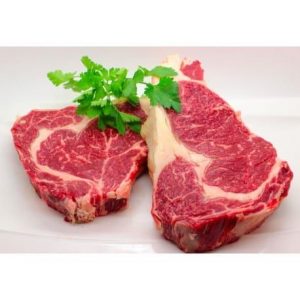
Two-steak packs of entrecôte from retinto mature cow or Black Angus for a weeknight, and a mature cow chuletón or a T-bone for the table: all of them at their best al punto.
2 retinto cow entrecôte steaks, 650 g
2 Entrecot Vaca Retinta 650 gr (Más vendido)30,90€ VAT incl.Add to basketChuletón (bone-in rib steak), retinto cow, approx. 1 kg
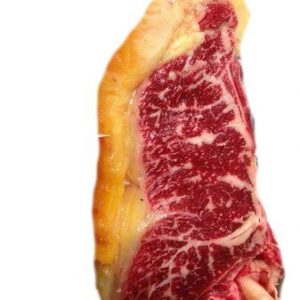
Chuletón Vaca Retinta - MAS VENDIDO57,90€ VAT incl.Add to basketT-bone steak, retinto cow
T-Bone Vaca Retinta Price range: 48,40€ through 50,60€ VAT incl.Choose weight


Doneness questions
What does al punto mean?
Literally “at the point”. On a Spanish menu or at a butcher’s counter it means medium-rare: pink from edge to edge, 54–57 °C (129–135 °F) at the core.
What temperature is medium-rare in Celsius?
54–57 °C at the core, which is 129–135 °F. Rare is 50–52 °C (122–126 °F) and medium is 60–63 °C (140–145 °F). Take the steak off 3–5 °C before the figure you want.
How do I ask for a rare steak in Spain?
Say “poco hecho, por favor”. For blue, say “muy poco hecho”. If you want medium-rare but worry it will come out overdone, “al punto, tirando a poco hecho” does the job.
Does a steak keep cooking after it comes off the heat?
Yes. The core gains 3–5 °C (5–9 °F) while the meat rests, so a steak taken off at 57 °C (135 °F) is eaten at about 62 °C (144 °F). Allow for it, and rest the steak before you cut it.