
Grand reopening, now taking pre-orders: 20% off everything until Wednesday 4 November, 17:00
Order now and secure your cuts. The first orders ship on Wednesday 4 November with SEUR Frío (refrigerated courier) and arrive the next day (Balearic Islands: two days).
On orders over €129: free delivery and a free tray of 4 criollo sausages.
Ox cheek · Beef cheeks · Carrillada · Slow braise
How to Cook Ox Cheek: The Spanish Carrillada Braise, Step by Step
Ox cheek (US: beef cheek), carrillada or carrillera in Spain, is the animal’s chewing muscle: hard-working and full of collagen. Braise it gently for 2.5–3 hours in a covered pot, or 45–50 minutes in a pressure cooker, and the collagen turns to gelatine. Allow 250–300 g raw per person, because it loses around 30% of its weight in the pot.
- 2.5–3 hours on a low heat, or 45–50 minutes under pressure
- Done when a knife goes in with no resistance: trust the knife, not the clock
- 250–300 g raw per person; better made the day before
Why this cut needs time
The cheek is the muscle the animal chews with, and that constant work defines it. A muscle that moves a lot is a muscle with a lot of connective tissue, which means collagen. Raw, it comes with membranes on the outside, and it is nothing like a steak.
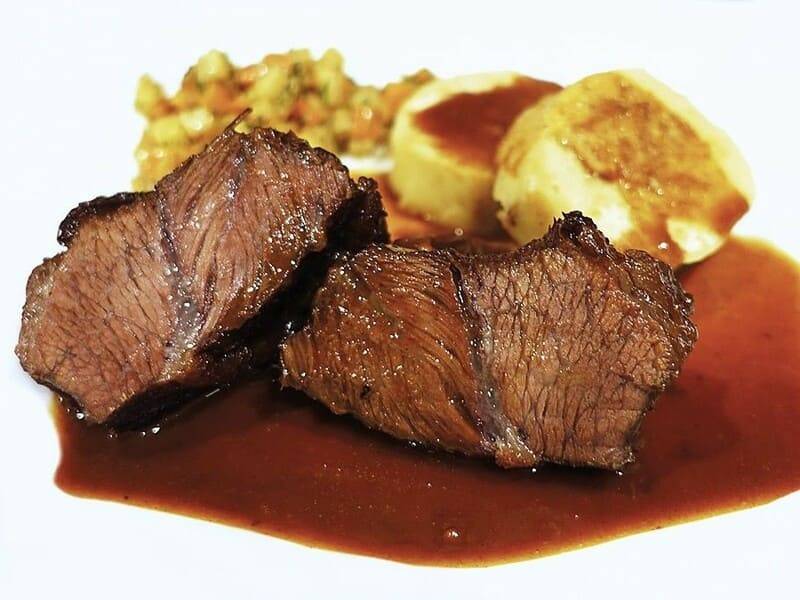
Collagen is tough when it is cooked fast: on a griddle an ox cheek would be inedible. With gentle heat and time, the same collagen breaks down into gelatine, the meat opens under a spoon and the sauce has body. Turning the heat up does not shorten the braise, it only dries the meat. The one real short cut is a pressure cooker.

What goes in the pot
- Ox cheeks, 250–300 g raw per person
- A little oil for browning
- Onion, carrot, leek and garlic
- Red wine, or Pedro Ximénez for the Andalusian version
- Stock to cover
- Salt
The method
- Trim. Take off the outside membranes and surface fat with a thin knife and some patience. They do not melt the way the collagen inside does.
- Brown. In the pot you will braise in, with a little oil, brown the cheeks on all sides. Lift them out. What sticks to the bottom is flavour for the sauce.
- Soften the vegetables. In the same oil: onion, carrot, leek and garlic. Medium heat, no hurry, until they are soft.
- Add wine and stock. Return the meat to the pot. Pour in the red wine and let the alcohol cook off. Then add stock to cover.
- Cover and cook slowly. Lid on, heat low, the liquid barely moving. The test is not the clock: it is a knife going in with no resistance.
- Blend and reduce the sauce. Take the meat out, blend the sauce with its vegetables and reduce it over a high heat until it has body. Put the meat back in the sauce and it is ready.
| Method | Time | When it is done |
|---|---|---|
| Covered pot on the hob, low heat | 2.5–3 hours | A knife goes in with no resistance |
| Pressure cooker | 45–50 minutes | Open, check and give it a few more minutes if needed |
| Sauce | Until it has body | Blended and reduced, with the meat out of the pot |
After a pressure cooker the sauce has to be reduced with the lid off, because nothing evaporates under pressure.
Red wine or Pedro Ximénez
The most widespread version uses red wine. The Andalusian version swaps it for Pedro Ximénez. The sauce comes out darker, with a touch of sweetness that suits this meat very well. Nothing else in the recipe changes.
Beef cheeks and ibérico pork cheeks are not the same
Cheeks from retinto yearling (añojo) are smaller and finer than those from a mature cow. Both are braised in the same way. Ibérico pork cheeks are another matter. They carry more fat and need less time. A recipe written for ibérico cheeks gives the wrong times for beef, and the other way round, and many Spanish recipes say only “carrilleras” without naming the animal. At a counter, say which you want: “carrilladas de ternera” for beef, “carrilladas de cerdo ibérico” for pork, and “limpias” if you would like the butcher to trim them.

How much to buy
Between 250 and 300 g raw per person. It sounds a lot, but ox cheek loses around 30% in the braise: 250–300 g raw leaves about 175–210 g on the plate.
- For 4 people: 1 to 1.2 kg raw.
- For 6 people: 1.5 to 1.8 kg raw.
Make it the day before
Ox cheek is one of those braises that improve overnight. The sauce settles and the meat soaks it up. With guests, that is an advantage: on the day all you do is warm it over a gentle heat.
What usually goes wrong
- Not trimming it. The membranes stay leathery on the plate.
- Too much heat. A rolling boil dries the meat before the collagen has melted.
- Serving the sauce unreduced. Watery, it is not the same dish.
Ox cheek and the other cuts for the pot
Retinto yearling ox cheek in 1 kg packs, which covers four people, and ibérico pork cheeks for the quicker version. Shin (jarrete or morcillo) and oxtail (rabo de toro) work on the same logic of collagen and time; the shin is a whole joint of approx. 2.5 kg, so plan to portion and freeze. All of them are on the stewing beef page.
Ox cheek (carrillada), retinto yearling beef, frozen
Carrillada de añojo31,90€ VAT incl.Add to basketIbérico pork cheeks (carrilladas), 1 kg
Carrilladas de cerdo ibérico -1KG30,36€ VAT incl.Add to basketOxtail (rabo de toro)
Rabo de Toro o Añojo 1,5 kg Price range: 35,90€ through 349,90€ VAT incl.Choose weightDiced stewing beef, retinto yearling, 1 kg
Carne Tacos Añojo Retinto, 1 Kg24,90€ VAT incl.Add to basketShin of beef (jarrete / morcillo), whole retinto joint, approx. 2.5 kg
Jarrete de Vacuno Retinto — Morcillo, Garrón o Brazuelo Premium. Pieza completa de 2,5 kg aprox.57,90€ VAT incl.Add to basket


Ox cheek questions
Are carrillada and carrillera the same thing?
Yes: two names for the same piece, the animal’s cheek, and which one you hear depends on the region. Menus often use the plural, because each animal has two. More names are in the guide to beef cuts in Spanish.
How long do ox cheeks take to cook?
Between 2.5 and 3 hours over a low heat in a covered pot, or 45–50 minutes in a pressure cooker. They are done when a knife goes in with no resistance.
How much ox cheek per person?
Between 250 and 300 g raw per person. It loses around 30% in the braise, so about 175–210 g reaches the plate.
Can I cook ox cheek the day before?
Yes, and it improves overnight. On the day, warm it through over a gentle heat.
Are beef cheeks and ibérico pork cheeks cooked the same way?
No. Ibérico pork cheeks have more fat and need less cooking time. The times from one recipe do not work for the other.