
Grand reopening, now taking pre-orders: 20% off everything until Wednesday 4 November, 17:00
Order now and secure your cuts. The first orders ship on Wednesday 4 November with SEUR Frío (refrigerated courier) and arrive the next day (Balearic Islands: two days).
On orders over €129: free delivery and a free tray of 4 criollo sausages.
Asado a la cruz · Iron cross · Wood fire · Four to five hours
Asado a la Cruz: How to Cook Meat on an Iron Cross Beside the Fire
Asado a la cruz is the Argentinian way of roasting large bone-in cuts on an iron cross planted at an angle beside a wood fire, not over it. The heat arrives sideways, gentle and constant, so a whole rack of beef ribs takes 4–5 hours and cooks through without burning. Distance from the fire is the only thermostat.
- The fire burns beside the meat, never underneath
- Bone side to the fire first; turn only at the end
- Brushed with brine every half hour, not salted dry
Heat travels sideways too
The cross is the most spectacular way to cook meat outdoors, and the slowest. It is also the one that teaches a lesson which changes how you use an ordinary barbecue (US: grill): heat does not only rise. It radiates.
The meat is fixed to an iron cross and the cross is planted in the ground, leaning towards a fire that burns next to it. The heat reaches the meat by radiation, soft and steady. No fat drips on the embers and nothing flares up. That is why a cut that would burn on a grill in twenty minutes can stand here for five hours and come off cooked from one side to the other.
What goes on the cross
Large pieces on the bone: a whole rack of beef ribs, half a lamb, half a kid goat, a suckling pig. Small cuts make no sense on a cross.
For a first attempt, choose the rack of beef ribs. It forgives far more than a lamb does, and it feeds eight to ten people.
| On the cross | Ask for it in Spain as | Total time | How it goes |
|---|---|---|---|
| Whole rack of beef ribs, 6–8 kg | Costillar de ternera, entero | 4–5 hours | 3 hours bone side to the fire, the remainder meat side |
| Half a lamb | Medio cordero | 3–4 hours | 2 hours bone side to the fire |
| Suckling pig | Cochinillo | 3 hours | Nearly all of it bone side; a final turn for the skin |
Always start with the bone side facing the fire. The bones act as a shield and let the meat cook without being attacked. The turn comes only at the end, to brown the other face.
The fire, and the only control you have
Wood, burned to one side
Build a wood fire a little apart and keep shovelling embers from it towards the foot of the cross. Use hardwood, leña of holm oak (encina), oak (roble) or quebracho. No pine and no treated timber.
Distance is the thermostat
There are no knobs. If the meat is cooking too fast, move the cross away; if it is too slow, bring it closer. Start far off, at about 80 cm, and close in gradually over the hours.
Brine, not dry salt
On the cross you do not salt the meat dry. You brush it with brine, salmuera, every half hour:
- 1 litre of water
- 100 g of coarse salt (sal gruesa)
- Optional: a few cloves of garlic and a few sprigs of rosemary
The brine keeps the surface moist for hours and seasons the meat little by little. It is brine that goes on the brush, not chimichurri: the vinegar and garlic in the sauce would burn and turn bitter. The chimichurri waits on the table.
How to tell when it is done
Without a thermometer, read the bones. When the ribs come apart by themselves as you pull with your hand, and the meat has shrunk back to leave a couple of centimetres of bone showing, it is ready.
With a thermometer, look for 70–75 °C (158–167 °F) in the thickest part. This is not a pink-centre cook. The aim is melted collagen, and that takes temperature and hours. Compare a steak: a chuletón comes off at 52 °C (126 °F).
What the cross teaches you about your own barbecue
That indirect heat exists and is on your side. The gentle zone of a charcoal barbecue, the third of the grate with almost no coals under it, is a cross in miniature. It is where thick cuts are finished without burning. Once you have understood the cross, you have understood why your thick steaks used to char on the outside. Setting up those two zones is covered in how to light a charcoal barbecue.
The same meal without the ironwork
The cuts of an Argentinian asado also work on a normal grill with a two-zone fire. Tira de asado is short ribs cut across the bones in strips, which belong on the gentle side like any rib, and vacío is the grill name for flank steak. For the lamb joints we sell, see the lamb page.
Asado cuts for the grill you already own
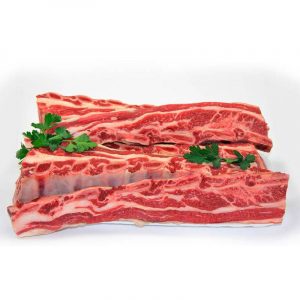
These are the asado cuts for an ordinary barbecue: retinto short ribs, flank, a whole picanha, and the criollo asado box for eight to twelve. If you want a whole rack for a cross, write to us on WhatsApp before you order and ask.
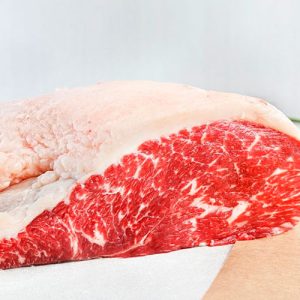
Whole picanha (rump cap), 100% retinto, 1.5–2 kg
Picanha 100% Retinto, pieza completa 1,5 a 2 kg59,90€ VAT incl.Add to basketCriollo asado box (approx. 5.6 kg)
Kit Parrillada Criolla del Maestro95,00€ VAT incl.Contains processed meat: ask us for the allergen listView product

Questions about the cross
How long does asado a la cruz take?
A whole rack of beef ribs of 6–8 kg takes 4–5 hours, half a lamb 3–4 hours and a suckling pig about 3 hours. Most of that time is spent with the bone side facing the fire.
How far from the fire should the cross stand?
Start at about 80 cm and move it closer as the cook goes on. Distance is the only control: further away to slow down, closer to speed up.
Do I salt the meat beforehand?
No. Brush it every half hour with brine made from 100 g of coarse salt per litre of water, with garlic and rosemary if you like.
What internal temperature am I looking for?
70–75 °C (158–167 °F) in the thickest part. The goal is melted collagen, not a pink centre. Without a thermometer, the ribs should pull apart by hand and show a couple of centimetres of bare bone.